Table of contents
For a developer that has spent the past two decades expanding across Dubai’s coastline, its creek and its inland hills, the decision to return to Downtown for another flagship release is, on the surface, almost surprising. Emaar Properties is no longer a single-district business. It is a diversified urban operator with master communities running from the Marina to Creek Harbour. And yet, the latest Downtown launch suggests that the company’s centre of gravity, both financial and symbolic, remains where it has always been.
A Strategic Return to the Origin
The narrative of Dubai real estate over the past five years has been one of geographic diversification. Beachfront product has expanded along the coast. Inland masterplans have opened up vast new freehold supply in areas including Dubai Hills and Arabian Ranches. Dubai Creek Harbour, itself an Emaar creation, has been positioned as the next-generation Downtown. Reading those signals, an outside observer might reasonably have concluded that the original Downtown district had reached its commercial maturity and would be allowed to season into a stable, secondary-market asset.
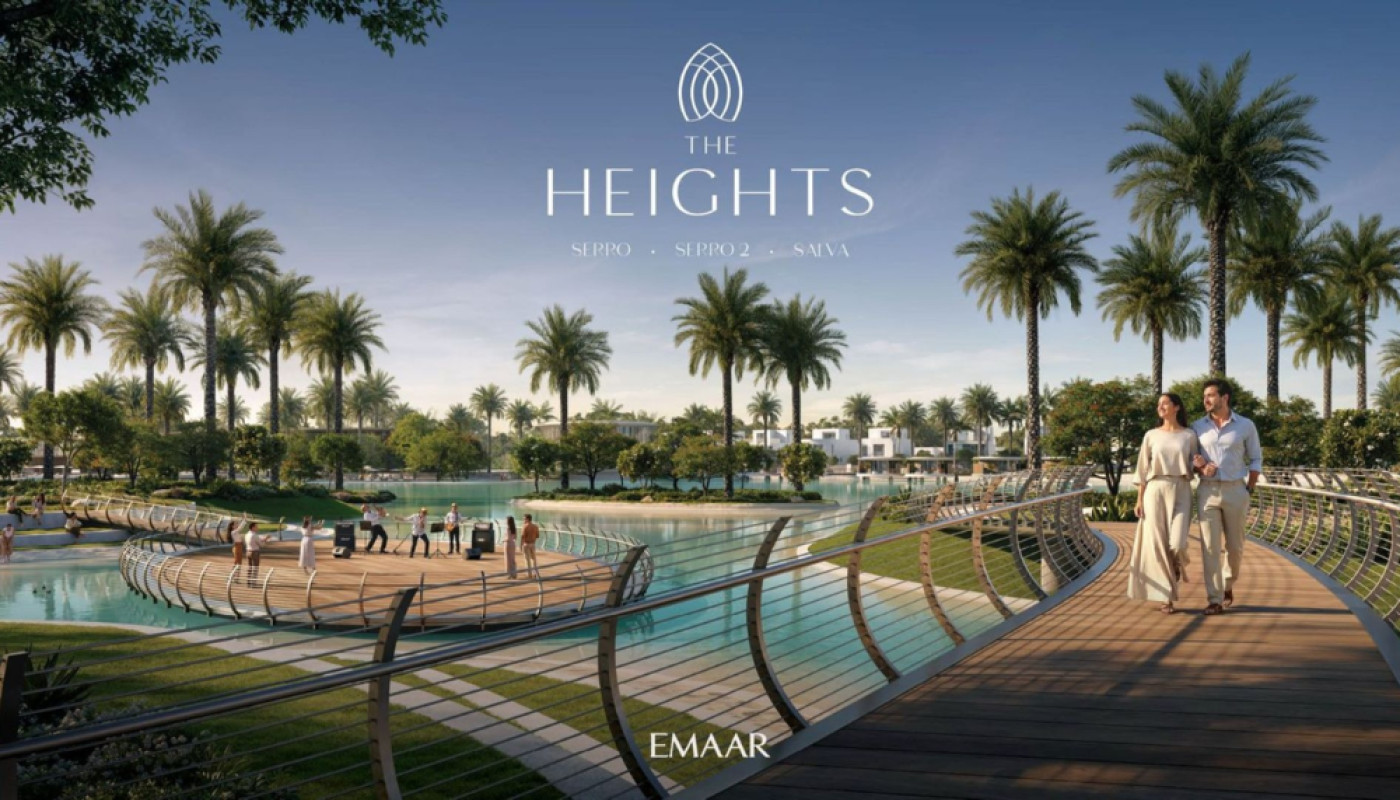
The arrival of The Heights by Emaar signals the opposite. The decision to deploy a new flagship release inside the original Downtown grid, rather than further inland, is a deliberate reassertion that the district remains the developer’s most important calling card. It is also a statement about where Emaar believes its highest-margin business continues to live.
JLL’s recent MENA real estate analyses have repeatedly highlighted that average ticket sizes inside the Downtown masterplan continue to outstrip those in most other Emaar communities, with the exception of selected beachfront releases. Knight Frank’s Dubai Prime Residential coverage has noted that the district has retained its position at the top of the city’s prime hierarchy even as new prime addresses have emerged. Against that backdrop, returning to Downtown is a logical, even disciplined, capital allocation.
Reading the Land-Bank
Land-bank strategy is one of the less glamorous but more revealing dimensions of any master developer’s playbook. Emaar’s annual disclosures and investor presentations, accessible via the Dubai Financial Market, indicate that the company retains development potential across a portfolio of strategic locations including Downtown, Dubai Creek Harbour, Emaar Beachfront, Dubai Hills, Dubai Marina, Arabian Ranches and several emerging communities.
What makes Downtown distinct in that portfolio is not the size of the remaining land-bank but its scarcity. Once the original Downtown masterplan is fully built out, no further inventory will be created inside that particular grid. New towers along the boulevard, around the lake or in close proximity to the Burj Khalifa belong to a finite supply curve that is now visibly tightening. This is the structural feature that drives much of the long-term commentary around the district. It is also the feature that gives a new Emaar Downtown launch a different character from a launch in a younger community.
In capital-allocation terms, deploying construction capital into a remaining Downtown plot tends to produce a faster sales velocity and a higher revenue density per square metre than the equivalent allocation in a less constrained district. That is the strategic calculation behind the timing of Emaar’s new Downtown tower.
Capital Allocation and the Question of Margin
Emaar’s investor commentary, as covered by Bloomberg and Reuters Middle East over the past two cycles, has consistently underscored the importance of premium urban product to the developer’s revenue mix. The company’s portfolio includes recurring income from retail, hospitality and entertainment assets, with Dubai Mall remaining the single most-trafficked retail venue in the region. But the residential development arm continues to be a significant contributor to top-line sales, and within that, Downtown product tends to carry the highest gross margins.
Industry observers have frequently noted that branded and master-developer residences inside flagship districts hold their pricing better through cyclical slowdowns than equivalent units in non-flagship locations. The premium is not simply emotional. It is rooted in the difficulty of replicating the address, the predictability of the buyer profile, and the resale liquidity that comes with a recognised global product.
From a corporate finance perspective, the decision to time a new Downtown release at this stage of the cycle reads less as a discretionary marketing move and more as a deliberate optimisation of the development pipeline.
How Markets Tend to React
Emaar’s share price has historically responded to major launches and to the disclosures that accompany them. Bloomberg coverage of recent quarterly results has highlighted that strong residential sales and increased booked revenues have been associated with positive short-term price action in the stock. The relationship is not mechanical, but it is observable across multiple cycles.
A Downtown launch, in that sense, functions as more than a real-estate event. It is a corporate signal. Analysts following the DFM tend to interpret a fresh release inside the flagship masterplan as evidence that the developer’s pipeline remains active, that demand remains supportive of premium pricing, and that the company is choosing to extract value from its highest-margin land-bank rather than rotate exclusively into newer districts.
Why Downtown Remains the Cash-Cow
There is a temptation, particularly in coverage that focuses on Dubai’s newer beachfront and creek-front districts, to treat Downtown as a mature asset whose growth has peaked. The evidence, on closer reading, is more nuanced.
Bayut’s market summaries have noted persistent search interest for Downtown across both sales and rental segments, with apartment yields in the district remaining attractive in the global context of prime urban markets. JLL has highlighted that hotel occupancy in Downtown’s hospitality assets, several of which are themselves Emaar-operated, has held up through cycles when other prime tourism districts have experienced more volatility. The presence of the Burj Khalifa, the Dubai Mall and the Dubai Fountain creates a permanent footfall environment that very few global districts can match.
For a developer, this combination produces a particular kind of long-duration asset. Buyers acquire homes that sit inside a permanent tourism amplifier. Rental demand is supported by both expatriate residents and short-term visitors. Resale liquidity benefits from the international recognisability of the address. These structural features explain why Downtown continues to function as a cash-cow segment within Emaar’s portfolio, even as the developer expands aggressively elsewhere.
Comparable Strategic Plays Globally
Comparable strategic logic can be observed in other global master developers. Brookfield’s continued investment in central Manhattan despite its presence in newer New York districts, or Lodha’s deliberate concentration of flagship product in South Mumbai’s Worli corridor despite its expansion into the city’s suburbs, follow a similar architecture. The pattern is straightforward. Once a developer has authored an iconic district, the marginal capital allocated to that district tends to be among the highest-return capital it can deploy, both in absolute terms and in branding terms.
Emaar’s decision to return to Downtown with a flagship release belongs to this category. It is not a defensive move. It is an offensive one, anchored in the belief that the district can continue to absorb premium new supply and that its global brand equity has not yet plateaued.
How The Heights Fits the Strategy
The product positioning of Emaar’s latest flagship at Downtown reflects the strategic logic. The mix of studios through four-bedroom apartments and penthouses targets a broad cross-section of buyers, from international investors seeking compact, view-oriented units to family end-users prepared to commit to Downtown as a primary residence. The vertical layout maximises exposure to the highest-value view corridors. The architectural treatment continues the developer’s Downtown vocabulary, ensuring that the building reinforces rather than dilutes the district’s identity.
From a balance-sheet perspective, this kind of release is generally efficient. Construction risk is moderated by Emaar’s mature supply chain. Sales velocity is supported by the developer’s broker network and by the international recognisability of the address. Payment plans, typically structured around a 60/40 or 70/30 split between construction and handover, are calibrated to attract international buyers while preserving the developer’s working-capital profile.
For investors comparing the project with other Emaar releases, the underlying argument is consistent. The Heights does not aim to be a stylistic outlier. It aims to be a disciplined extension of a successful product franchise inside the developer’s most valuable district.
Fiscal and Visa Tailwinds
The strategic case is reinforced by the fiscal regime around Dubai property ownership. The UAE imposes no personal income tax and no capital gains tax on real estate. Freehold ownership is available to foreign nationals across Downtown. The Golden Visa programme grants ten-year residency to property buyers whose investment exceeds AED 2 million, a threshold that aligns naturally with the pricing of Downtown product.
For international buyers, this combination of fiscal neutrality, visa pathway and trophy address produces a value proposition that international coverage, including Khaleej Times and Arabian Business, has repeatedly framed as one of the more compelling globally. From Emaar’s perspective, these external tailwinds reduce the marketing friction around premium launches. Buyers do not need to be convinced of the macro case. They arrive already familiar with it.
What the Bet Says About the Next Cycle
A development decision of this scale is not made in isolation. It carries an implicit statement about the next several years of the Dubai market. By returning to Downtown with the new Burj Khalifa-adjacent tower, Emaar is signalling that it expects sustained absorption of premium product at the top of the market, that it sees continued international demand for trophy Downtown addresses, and that it views the remaining flagship plots as too valuable to leave undeveloped during this part of the cycle.
That is not a bet on novelty. It is a bet on continuity. The Downtown district has been one of the most reliable real-estate engines in the Middle East for fifteen years. Choosing to deploy another flagship release inside its perimeter rather than disperse capital across newer geographies is a reasoned, disciplined choice. It also tells brokers, buyers and analysts where the developer believes its franchise still has the most room to grow.
In the cool language of capital allocation, that is the most informative statement a master developer can make. And in Dubai, where launches are read as cycle signals, it is being received accordingly.
On the same subject


